
The Coal Mines of Cannock Chase, Part I
Community Exhibitions – February 2026
____________________________________________________________________________________________________________________________________________________
In our first series for Chase Collections, the team has put together a selection of blogs on coal mining in the Cannock Chase district. In conjunction with exhibitions at libraries across the area, we have explored the history of six local mines, touching on the influence of war, technology, and nationalisation, and just how important the industry was.
______________________
Early evidence suggests that mining began far beyond living memory, with medieval bell pits recorded in the late 1200s, with coal and ironstone being sourced from this point onwards. However, the industry as many know it began to form following the First Industrial Revolution, and in the century that followed, coal mining played a significant role in shaping communities across Cannock Chase. A source of employment and community for many, the collieries became central to life in the area, and by 1913 approximately 20,400 men were working across the coalfield. The growth of the industry influenced infrastructure development, with housing and education required to support miners and their families, while the local landscape and economy were equally affected.
The late nineteenth century saw coal mining advancing rapidly, with large-scale operations on the horizon. In the decades that followed, more mines were established and controlled by companies leasing land, some from the Marquis of Anglesey. These companies each had distinct identities but shared a focus on production and expansion.
Deep coal mining developed rapidly in the late nineteenth century. Valley Colliery, which opened in 1874, was the first deep coal mine in the coalfield and marked the beginning of large-scale mining in the area. Over the following decades, further collieries were established as demand for coal increased and transport networks expanded. As mining continued into the late twentieth century, the industry declined, and the final deep mine in the coalfield, Littleton Colliery, closed in 1993.
Working underground was dangerous and demanding. Accidents and fatalities occurred frequently across the district, as they did nationally. For many, mining became a profession passed down through generations, while for others, such as the Bevin Boys, it was work assigned as a necessary contribution to the war effort. By remembering the history of the mines, we aim to keep their memories alive.
Disputes and strikes are another important aspect of the coalfield’s history. Their lasting impact can still be felt by miners, their families, and local communities, just as the absence of the industry is reflected in today’s landscape. It would be impossible to explore this history without acknowledging events that remain deeply personal for many.
______________________
Across these blogs, Chase Collections explores several individual collieries within the coalfield, each with its own story. Together, they reflect changes in working conditions, technological developments, and key events that shaped the wider coal industry over time.
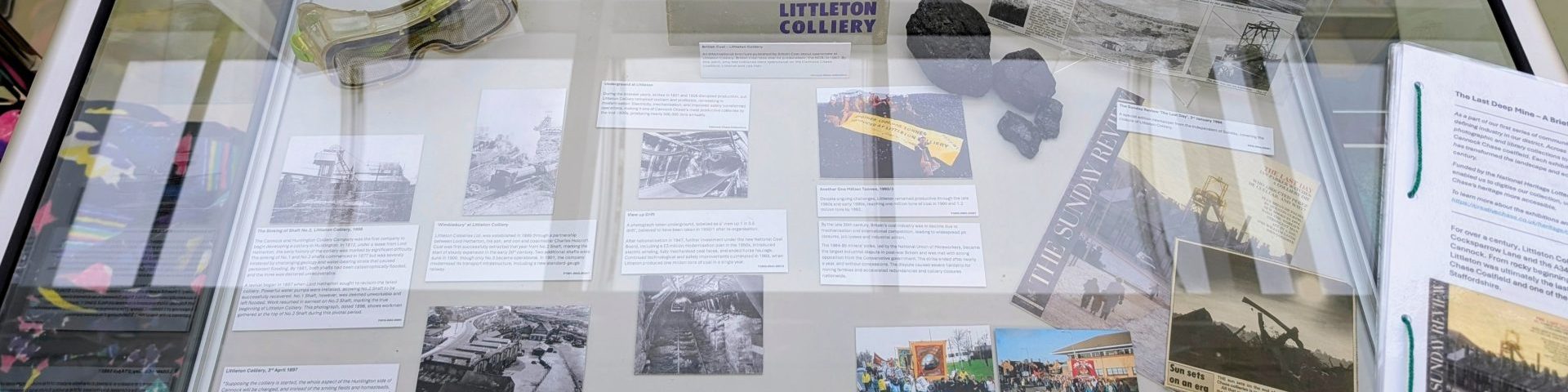
The corresponding exhibitions featuring Cannock Chase Collections will be displayed at Cannock Library, Heath Hayes Library, Hednesford Library, Norton Canes Library, Rugeley Library, and the Marquis Drive Visitor Centre from mid-January until April 2026. These exhibitions offer the opportunity to view local history in person through photographs, documents, and books from our collections.
______________________
These histories have been made possible thanks to funding from the National Heritage Lottery Fund, which supported the Connecting Collections project and enabled our team to digitise a wide range of books, photographs, and objects. This work has laid the foundation for an accessible collection available to all, with outreach activities further expanding our reach. These items now form Chase Collections, continuing the legacy of the Museum of Cannock Chase. More news on when the collections database will be made public will be shared in the near future.
We hope you will join us in celebrating the heritage of our local area through both the exhibitions and the blogs, which will be published over the coming weeks, and we look forward to exploring more local stories soon.